


Because it’s the season for celebrating all things creepy and scary – in the US, Halloween happens at the end of October – we wanted to pause to appreciate a specimen of true horror and dread: the vampire amoeba.
When this shapeshifting, single-celled organism shows up, all those poor critters on which it feeds – algae, fungi, other protists – run off, screaming in terror. Or at least we like to imagine they do. Or would, if they could.
Because that’s certainly what we would do, if we were only a few micrometers tall. These terrifying blobs reach out with long tentacles to grab hold of their prey, often things much larger than themselves. Like Count Dracula himself, they pierce an organism’s outer skin and suck out the cytoplasm and organelles within. While digesting, their cytoplasm can turn red, like blood.
This particular group of amoebae lives in a wide range of habitat types, including soils, although it’s relatively rare for us to find one. The amoebae we observe in soils are most often ‘testate,’ usually hunkering down inside protective shells. All vampire amoebae are of the ‘naked’ type, lacking tests. They are classified in the genus Vampyrella, within the order Vampyrellida (although similarly named, the larger group contains many other types of predatory amoebae).
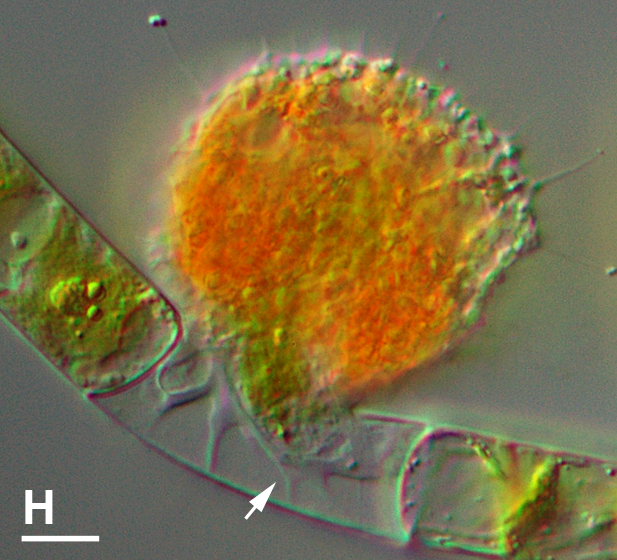
Vampyrella lateritia emptying algal cell: Sebastian Hess, Nicole Sausen, Michael Melkonian (2012). Header image: Hess, Sausen, Melkonian (2012), cropped and arranged.
Most amoebae catch their prey by reaching out with some form of pseudopod to grab it, and then begin wrapping around it. The captured organism quickly finds itself inside a vacuole, which is basically an air bubble circulating around in the fluid cytoplasm of the amoeba’s interior. Digestive enzymes are then secreted, and this fresh morsel is dissolved and consumed.
But of course competition out there can be downright frightening, and so the Vampyrella have devised a method for feeding on larger things. Once they’ve attached to the wall of something big and stationary, like an algal filament, they then secrete those enzymes through their outer membrane, thereby dissolving a hole through the victim’s cell wall. And, presto: a feast of protoplasm (the soup of a cell’s interior, its organelles floating around in cytoplasm) is there to be had.
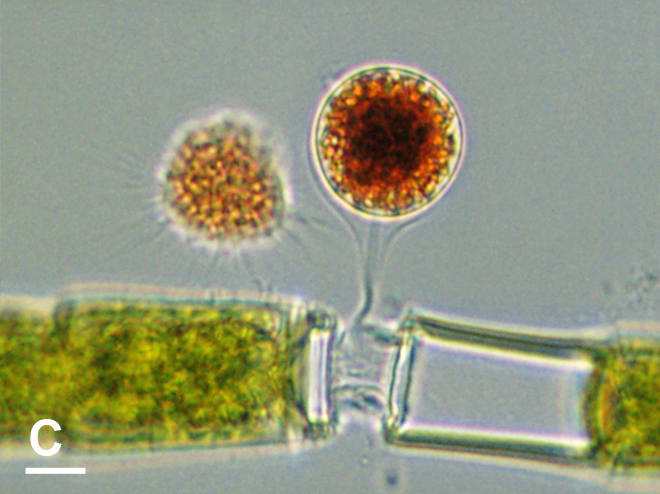
Vampyrella pendula on Oegonium: Sebastian Hess, Nicole Sausen, Michael Melkonian
Another cool feature: After feeding, these amoebae need time to digest, which involves a period of lethargy, as it does with most of us living organisms. Lethargy means greater vulnerability to predators, a problem the Vampyrella solve by creating a protective cyst in which they can spend a portion of the process, drowsily processing that last meal. You might say it’s a little like Dracula retiring to his coffin after a satisfying night of hunting, stalking and blood-sucking.
We hope everyone has a fun and safe season of celebrating the ghoulish, the undead, and all that is strange and fascinating.
